
Resolve Conflict, Reconcile Relationships, Negotiate Agreements, Restore Peace
We know how painful conflict can be. Whether it’s a strained friendship, a stab on social media, a critical coworker, a marriage headed toward divorce, a threatening lawsuit or a church plagued by division, conflict can suck the life out of us … as these 8 Church Nightmares illustrate.
But don’t give up, because conflict also provides an opportunity to experience and model God’s peacemaking wisdom and grace … as illustrated by the real-life examples later on this page.
RW360’s vision is to equip, empower and assist you to respond to conflict in ways that promote justice, encourage reconciliation and inspire personal growth.
We provide this assistance in three phases.
You can use personal peacemaking skills to resolve most conflicts on your own.
Informal mediation by trusted leaders can settle more difficult cases.
Certified Conciliators can provide formal mediation or binding arbitration.
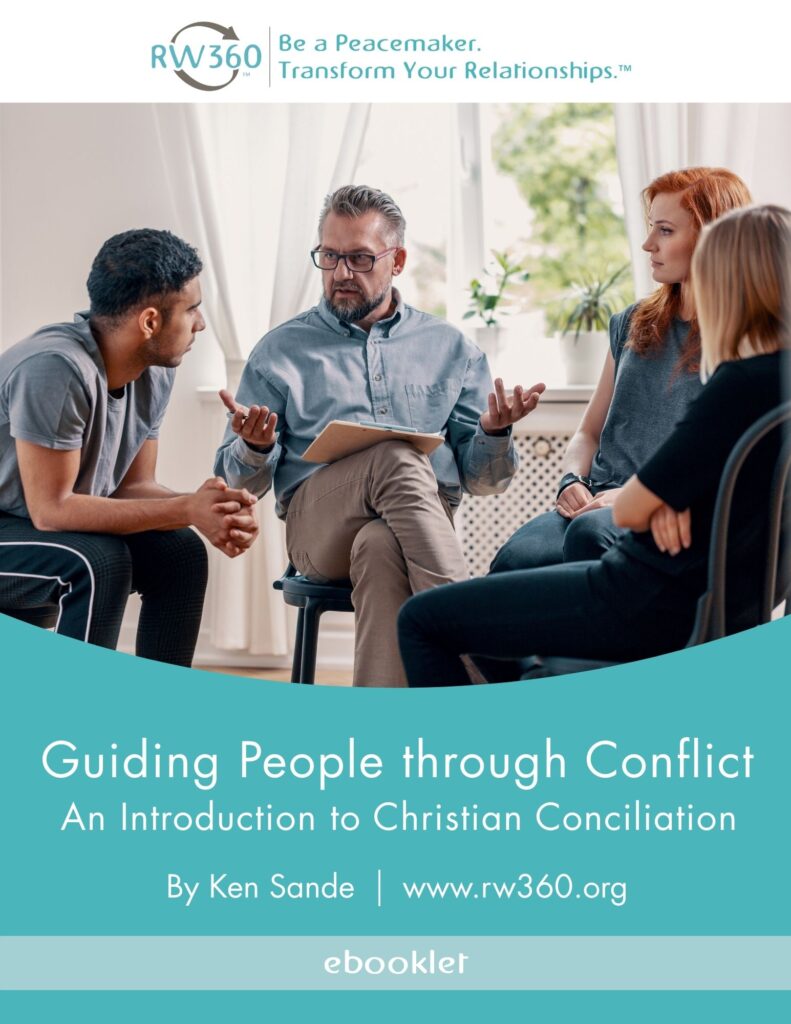
Many conflicts can be resolved personally and privately when people learn and apply the basic principles of peacemaking (see Matt. 5:9; 5:23-24; 18:15). Therefore, before you seek conciliation assistance, we encourage you to study and apply the principles set forth in the first three chapters of Guiding People Through Conflict, which provide practical guidance on how to identify the underlying causes of conflict, how to confess, confront and forgive wrongs, how to negotiate just and reasonable agreements and when to seek outside assistance in resolving a conflict.
You will also find helpful guidance for personal peacemaking by completing the Transformed by the Gospel Bible Study. For more detailed guidance, read The Peacemaker: A Biblical Guide to Resolving Personal Conflict and use the Personal Application Workbook to apply these principles in your situation.
If you apply these simple but powerful principles with prayerful humility and charitable judgments, you will be surprised how often your example will trigger the “Golden Result ” as people begin to treat you the way you are treating them.
If you are unable to resolve a conflict through your own personal efforts, the next step is to seek assistance from your pastor, a church leader or a spiritually mature friend (see Matt. 18:16; 1 Cor. 6:1-8). Guiding People Through Conflict provides detailed guidance on how these individuals can assist you through informal conflict coaching, mediation or binding arbitration.
If other individuals are willing to assist you but need advice on how to do so, they may request guidance from a trained conciliator through RW360’s Conciliation Hotline.
Although many conflicts can be resolved through personal peacemaking or informal conciliation, some conflicts are so complex that it is wise to seek the assistance of professionally trained conciliators. Such assistance is especially helpful in these types of cases:
The Handbook for Christian Conciliation provides a detailed description of a formal conciliation process, including Rules of Procedure, Frequently Asked Questions and our Standard of Conduct for Christian Conciliation.
Professional conciliation typically costs between $150 and $250/hour and may cost over $500/hour in complex cases. Therefore, RW360 encourages parties to make every effort to resolve a conflict through personal peacemaking or informal conciliation before using the form below to submit a request for professional assistance. We also encourage you to read the FAQs below prior to submitting a request for assistance.

Conflicts involving emotional trauma, power imbalances or abuse (physical, emotional, sexual, child, elder, spiritual, etc.) require the involvement of conciliators or other professionals who are specifically trained to deal with these types of issues. If your situation may involve any of these dynamics, please indicate that when submitting a request for assistance.
Many abusers become skilled at twisting biblical principles to their advantage, including the principles taught in The Peacemaker. Therefore, if you are in an abusive situation, we encourage you to read Peacemaking and Abuse.
If there are credible allegations or signs of significant abuse, we will usually require an independent investigation to unearth hidden facts and patterns before proceeding with a conciliation process. When searching for qualified faith-based abuse investigators, we encourage you to consider these best practices.
If you are dealing with a situation involving domestic abuse, we recommend that you contact Beauty from Ashes directly, which specializes in providing conciliation and support services in these situations.
RW360 and our conciliators do not provide legal advice or representation. If the situation you are facing requires such assistance, please contact one of these organizations:
Divorce and child custody disputes often involve a combination of legal, financial, relational and spiritual issues. Conciliators do not provide professional legal or financial advice, but they are often able to assist parties to make progress on relational and spiritual issues by applying the principles of relational wisdom and biblical peacemaking. Sometimes this process opens the door for repentance and reconciliation and cancels the desire for a divorce. Even if reconciliation does not occur, conciliation can make it easier for parties to resolve other issues more reasonably and without a prolonged adversarial process.
Before you submit a Request for Conciliation Assistance form in a divorce or custody case (see link below), we encourage you to read through the following materials, asking God to help you, your spouse and your church see how these principles could be applied in your situation.
If these articles inspire you to continue working to save your marriage, we encourage you to seek individual or joint counseling from your pastor or a Christian counselor in your community, such as someone who has been trained through the Christian Counseling and Education Foundation.
Our Introduction to Christian Conciliation contains answers to many frequently asked questions.
It is usually wise to ask the other person to consider Christian conciliation before you contact us directly. This way the other person is less likely to think that you are trying to pressure him into this process or have already talked with us and biased us against him. Here is the type of message you could send the other party to suggest conciliation (edited to fit your situation):
As I’ve thought about the tensions that have arisen between us in recent days, I decided to search for an organization that might be able to help us resolve our differences in a way that would honor our shared faith, preserve our personal relationship and help us to reach an agreement that we both believe is fair and just.
Through my search, I came across the Christian Legal Society (CLS) and discovered a page on their website that describes the benefits of a faith-based form of alternative dispute resolution called “Christian Conciliation.” The CLS does not provide this service itself, but they do offer links to four respected conciliation organizations.
I would appreciate it if you would read the information about Christian conciliation to see if you think this is a process that might work for us. If so, please visit the websites of the four providers listed by the CLS and let me know which of these organizations you think would serve us most effectively.
If we can agree that this process is appropriate and also agree on which conciliation provider would serve us best, we will have taken a big step toward resolving our present differences in a constructive way.
The reason we suggest having the other party explore other organizations for conciliation services is that he is less likely to feel that you are trying to pressure him into using RW360. The more “agency” (freedom of choice) the other person feels, the more likely he is to agree to a conciliation process.
To make the other party even more comfortable using our services, you could allow that party to make initial contact with us by filling out the request for conciliation assistance form. After we receive that form, we would immediately contact you to learn your side of the story.
Yes. Our Certified RW Conciliators follow our Rules of Procedure for Christian Conciliation.
Yes. RW360 conciliators make a commitment to follow our Standard of Conduct for Christian Conciliators.
Yes. Conciliation parties may use RW360’s Conciliator Grievance Policy to report a violation of our Standard of Conduct.
Yes. You can go to this page to find several versions of conciliation clauses that you can use for commercial and employment contracts, church membership agreements and wills and trusts. Click here to see court decisions that uphold the validity of these types of clauses.
The best way to begin upgrading your relational and peacemaking skills is to take RW360’s free Relationally Wise Leader course, preferably with your entire leadership team. You can deepen your relational skills by taking our RW Shepherd course.
You will find detailed guidance on these principles by reading Bringing Relational Wisdom into Your Legal Practice.
Click here to see a history of the various ministries that provide Christian conciliation services.
Please read all the Frequently Asked Questions listed above before you fill out this form. These FAQs will help you to provide more accurate information and enable us to serve you more effectively. We also suggest that you read Guiding People Through Conflict and the Handbook for Christian Conciliation before you request assistance, but this is not mandatory.
Please download Interview Agreement and attached it at the end of this form.